
People often ask what makes Homeschooling Torah different.
The answer is actually quite simple.
When our children were young, we wanted our days to revolve around Scripture. We wanted the Word of God to be more than a subject we studied for thirty minutes before moving on to the “real” schoolwork. We wanted it to shape everything.
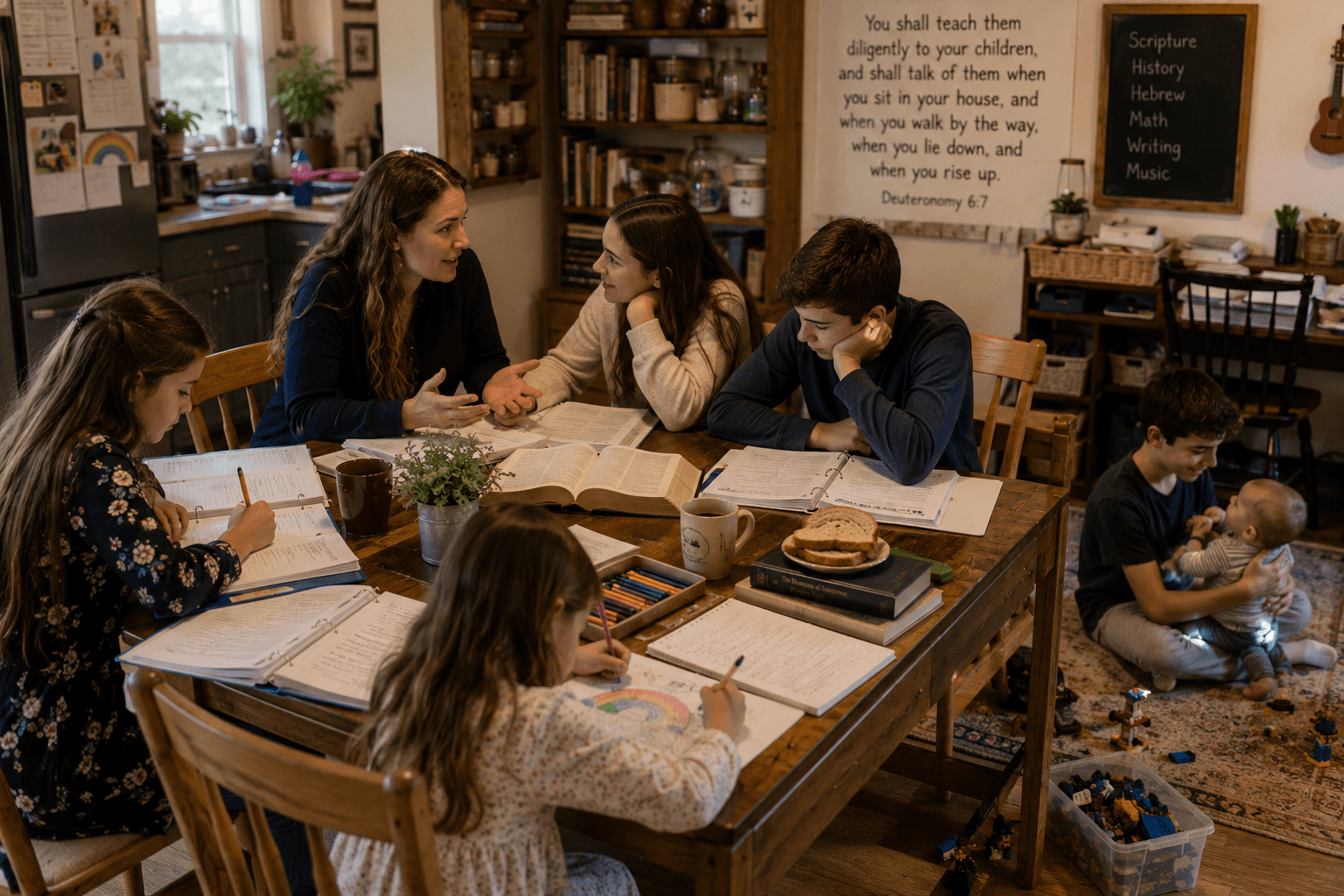
So each morning, we gathered around the table. We read Scripture together. We talked about it. We prayed. Then we learned history, language arts, science, music, and the rest of life through the lens of God’s Word.
Over the years, that simple desire became the foundation of our curriculum and our philosophy of education.
1. The Bible Is Our Primary Textbook
Our educational philosophy begins with a simple conviction: Scripture is sufficient to equip men and women of God for every good work.
“All Scripture is given by inspiration of God, and is profitable for doctrine, for reproof, for correction, for instruction in righteousness, that the man of God may be complete, thoroughly equipped for every good work” (2 Timothy 3:16-17, NKJV).
That does not mean we ignore history, science, mathematics, literature, or the arts. Quite the opposite. We believe all truth belongs to Yehovah.
But we also believe every subject should be understood in light of His Word.
Rather than treating the Bible as an occasional supplement, we make it the foundation. Everything else is built upon that foundation.
2. Our Goal Is Discipleship
Many educational programs focus primarily on academic achievement, college preparation, or career readiness.
While those things have value, they are not our primary goal.
Our desire is to help children become wise unto salvation through faith in Yeshua the Messiah (2 Timothy 3:15). We want them to know Yehovah, love His commandments, walk in His ways, and develop the wisdom needed to serve Him faithfully throughout their lives.
Education is not merely the transfer of information.
It is the training of hearts, minds, and lives.
3. The Home Is the Primary Place of Learning
Timothy learned the Scriptures from his mother and grandmother long before he became a leader in the faith (2 Timothy 1:5; 3:14–15).
That pattern is still effective today.
Parents have been given the privilege and responsibility of teaching their children diligently throughout the day (Deuteronomy 6:6–9). For this reason, we believe education is not confined to a classroom. It happens around the dinner table, during chores, while reading together, during family worship, and in countless everyday conversations.
The home is not merely where education happens. The home is the curriculum.
4. Families Learn Better Together
Modern education often separates children by age, ability, and subject.
Real life rarely works that way.
In our own home, we discovered that children learn a tremendous amount when they learn together. Younger children are inspired by older siblings. Older children strengthen their understanding by helping younger ones.
That is why much of our curriculum is designed for family-style learning.
We want parents discussing Scripture, history, Hebrew, and great ideas with children of many ages gathered around the same table.
Learning together builds relationships, strengthens families, and creates a shared foundation of knowledge and faith.

The Elliott children doing notebooking (2011)
5. Notebooking Helps Children Make Truth Their Own
One of the most distinctive features of our curriculum is notebooking.
Instead of simply filling in worksheets, children are encouraged to interact with what they are learning. They write, draw, organize, summarize, record observations, and express ideas in their own words.
Notebooking naturally combines reading, writing, critical thinking, and creativity. More importantly, it helps children slow down and process what they have learned.
A notebook becomes more than an assignment. It becomes a record of a child’s growth, understanding, and relationship with the subjects they have studied.
Our Prayer for Families
At Homeschooling Torah, we are not merely trying to help families finish school. We are trying to help families build homes where the Word of God is central.
Our prayer is that children would grow up knowing the Scriptures from their earliest years, loving Yehovah with all their hearts, and following Yeshua faithfully wherever He leads them.
If that happens, then we will consider our work a success.

0 Comments